New Componit

From Efficiency to Safety: Strategies, Benefits, and Real-World Applications of Industrial Thermal Insulation

Until now, evaluating the efficiency of an industrial technical insulation system was often based on assumptions, estimates or generic parameters.

As of December 1, 2024, with the entry into force of EN 17956:2024, companies finally have an objective, measurable and independent tool to evaluate the energy performance of their insulation system.

This is a paradigm shift that can transform an often neglected area, of the system, into a concrete lever of performance, sustainability and competitiveness.

What the standard EN 17956:2024 provides and why it marks a turning point

EN 17956:2024 is a European standard designed to bring transparency, comparability and scientific method to the evaluation of technical insulation systems.

At its heart is an energy rating system that assigns a score from A (highest efficiency) to G (lowest), based on the density of heat loss flux.

In practice: the more effective an insulation is at retaining energy, the higher its class will be. On the other hand, if it lets too much heat through (beyond the maximum value of class F), it will be classified as G.

This methodology represents a revolution for several reasons:

  • It is independent of the material used, since it evaluates the actual performance, not the brand or type of insulation.
  • It is applicable to any geometry, such as piping, flat surfaces, special components and any other shapes found in complex industrial plants.
  • It covers a wide temperature range, from -30°C to +650°C.
  • It is replicable and comparable, so any company can get a consistent and comparable assessment with that of other operators or plants.

For companies, this is a clear opportunity: to know exactly where, how much and why they are losing energy, in order to take targeted action.

But how does the EN 17956:2024 standard apply in practice? We look at it in the next few lines.

How the method works (and what it allows you to do)

The classification process according to EN 17956:2024 is structured in four key steps, designed to accompany the company from goal setting to reading the results.

1. Selecting the efficiency class

It always starts with a strategic choice: What is the level of energy efficiency I want (or can) achieve?

Choosing the desired class (from A to F) allows you to calibrate the intervention according to the expected ROI.

2. Identifying the process temperature

 Every plant has specific operating conditions. By indicating the operating temperature, you can calculate the thickness needed and the most suitable type of insulation to fall within the selected class.

3. Defining the geometry

The shape, size and type of the surface or component to be insulated (pipes, surfaces, flanges, etc.) are specified. This step is essential for reliable simulations.

4. Interpretation of results

The system returns the maximum allowable dispersion value for the chosen class, along with an indication of the minimum space required to meet it. This way you can check whether your current insulation is adequate–or how far you are from your goal.

From “technical cost” to strategic lever: the benefits for your company

Too often technical insulation is treated as a passive item in maintenance budgets, with invisible losses that, on a European scale, translate into huge economic costs every year.

Adopting EN 17956:2024 means changing your perspective:

  • You can accurately measure the efficiency of your insulation, with real data, not assumptions.
  • You can identify critical points in your system and plan a revamp with a measurable return on investment.
  • You can compare different solutions, without relying only on data sheets or sales brochures.
  • You can demonstrate compliance with regulations such as EED and IED, which are increasingly central to sustainability policies.
  • And above all: you can reduce consumption and costs, improving competitiveness and reducing your environmental footprint.

Do you want to know how to apply EN 17956:2024 to your plant ?

At New Componit, we can support you step by step: from the initial assessment to the performance simulation and the proposal of tailor-made solutions to meet the highest standards.

Get in touch with us to request a simulation based on the TIPCHECK method, our energy diagnosis protocol useful for identifying heat loss and quantifying potential savings.

You’ll find out where you’re losing energy and how much you could really save.

Because today, insulation is no longer just protection.

It’s a competitive advantage.

Want to improve comfort and performance in your plant with a tailored solution?

At the heart of combined cycle heat recovery boiler (HRSG) plants, controlling thermal expansion is one of the most complex challenges, for maintenance personnel and plant managers. Thermal and mechanical stresses, irregular operating cycles and high temperatures put a strain on the seal and reliability of components.

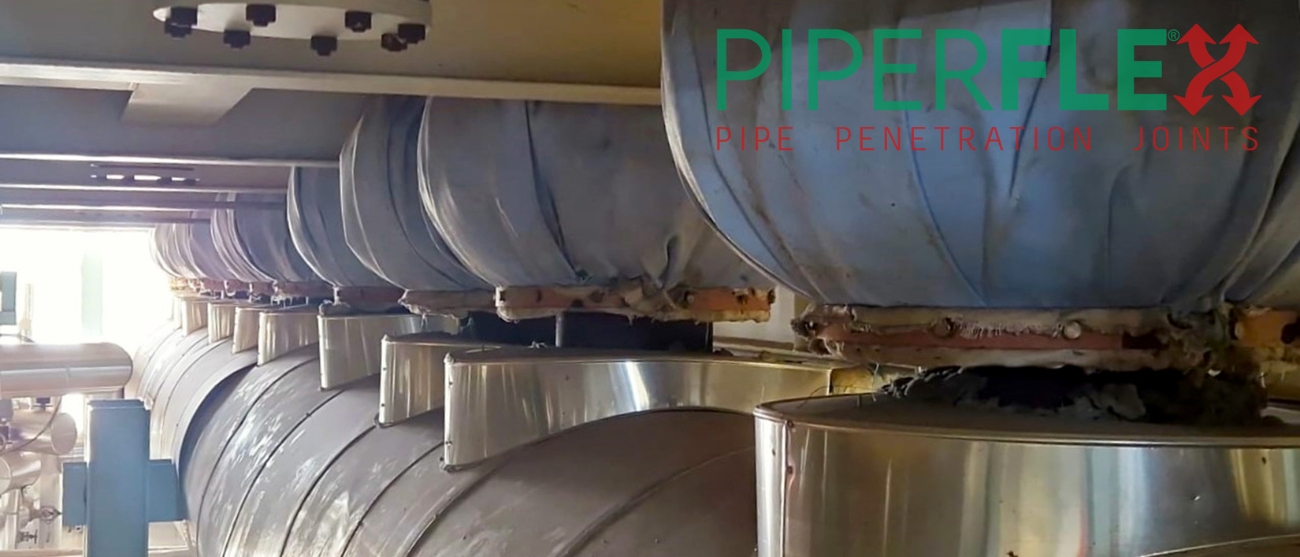
In this critical context Piperflex®  the textile through-wall expansion joint, designed by New Componit, establishes itself as one of the most effective and long-lasting solutions. A strategic choice that combines resistance, reliability and control, responding to concrete and increasingly pressing operational needs.

But what makes Piperflex® so reliable even in the most extreme conditions? Let’s find out point by point with a concrete look at its performance on the field.

Beyond the limits of metal expansion joints: Piperflex® in the most critical areas of HRSG plants

New Componit supplies textile expansion joints for all critical areas of combined cycle plants: from the air intake to the stack. In particular, Piperflex® is designed for the wall passages of HRSG boilers – an area subject to strong temperature changes, mechanical movements and high pressure.

This is where traditional solutions, such as metal expansion joints, begin to show their limits.

One of the strengths of Piperflex® is the ability to compensate for large axial and lateral movements ,protecting the structural integrity of the system and reducing the need for frequent interventions.

Unlike metal expansion  joints – which tend to wear out quickly under “stop & go” operating conditions – Piperflex® maintains high performance over time even in particularly unstable situations.

With a thermal resistance of up to 950°C and excellent gas tightness, this expansion joint is particularly suitable for the high temperatures typical of HRSG systems. Not only  it improves thermal efficiency, but it also helps to minimize the risk of dispersion and leakage.

Each Piperflex®  expansion joint is custom-designed: it is made after a careful analysis of the operating conditions of the plant, thanks to advanced design engineering, technical simulations and tests in a test chamber. The production is completely internal, to guarantee full control over materials quality and precision.

Also the installation is entrusted to highly qualified personnel, for an impeccable and long-lasting result.

More reliability, fewer surprises: Expansion Control System service

Piperflex® is not only an expansion joint. It is part of a comprehensive service that accompanies the customer at all stages: from design to post-installation maintenance. With the Expansion Control System program, New Componit provides a range of services designed to monitor the performance, identify potential problems and optimize plant management.

Technical support is provided by an international team of specialists, able to intervene anywhere in the world. This means controlled installation, on-site supervision, timely repairs and above all, preventive maintenance:an approach that prevents breakdowns, reducing operating costs and extending system life.

At a time when unplanned outages can cause considerable economic damage, having a joint that ensures operational continuity makes all the difference. Piperflex® is designed to resist, adapt and last and it does so without compromise.

Concrete benefits of Piperflex® include:

  • Superior reliability compared to metal expansion joints, even under irregular cycles
  • Maximum thermal resistance up to 950°C
  • Ability to absorb axial and lateral movements
  • Perfect gas tightness even under complex operating conditions
  • Custom and in-house manufacturing, with engineering materials selected to ensure high performance over time
  • Installation performed by certified teams
  • Ongoing technical support and proactive maintenance

Piperflex® is also a strategic asset for HRSG plants. Choosing it means reducing unscheduled shutdowns, containing downtime and achieving a tangible return in terms of business continuity and long component life

The robustness of an HRSG plant is also built through decisions that affect the most critical and stressed areas, when we talk about elements exposed to extreme conditions, what matters is the quality of the design and the precision of the implementation. Piperflex® is much more than a textile expansion joint: it is a guarantee of performance, a protection you can count on and an investment focused on operational continuity and sustainability.

Want to improve comfort and performance in your plant with a tailored solution?

In the era of digital transformation, information security has become a vital pillar to protect both business and customer data. With ever-evolving cyber threats, ensuring a secure environment is not just a priority but a strategic responsibility for every company.

However, guaranteeing security doesn’t just mean adopting cutting-edge technologies – it requires a deep cultural shift that involves every level of the organization.

At New Componit, we’ve embarked on an ambitious journey to strengthen information security, guided by three main pillars: continuous training, proactive technology, and a culture of collaboration. This journey is not just an investment to protect our company but also a commitment to ensuring that our clients’ data is always secure.

Continuous Training: The Heart of the Strategy

At New Componit, we firmly believe that the first step toward enhanced security lies in people. Every member of our team is an active participant in this journey, as individual awareness and preparation are our greatest allies. Technology alone isn’t enough—if people aren’t trained to recognize and handle threats, the entire security system can become vulnerable.

Continuous training is, therefore, the heart of our strategy. We regularly organize sessions that go beyond theory, offering practical and immediately applicable tools. For instance, our team members learn to:

  • Identify and handle phishing emails.
  • Create and store secure passwords.
  • Apply best practices for protecting sensitive data.
  • And much more.

This approach allows us to transform every employee from the “weakest link” in the chain into the “first line of defense” for the company.

Information security cannot be delegated—it is a shared responsibility involving everyone within the organization.

Technology and Prevention: A Proactive Approach

If people are the heart of the strategy, technology is the backbone of our security system. While absolute security may not exist, a preventive and dynamic method can make a significant difference.

We utilize advanced technological solutions to monitor our infrastructure in real time, identifying and mitigating threats before they can cause harm. These technologies enable us to:

  • Constantly monitor data traffic and suspicious behaviors.
  • Quickly identify vulnerabilities and take immediate action.
  • Protect both company and customer data, reinforcing the trust they place in us.

With these tools, we can ensure a safer environment for our processes and, consequently, for our partners’ operations. Trust is a crucial element in any business relationship, and information security is one of the best ways to build and strengthen it over time

Information Protection: A Team Effort

Information security is not a destination but a continually evolving journey. Every day brings new threats, and we are committed to anticipating and addressing them with determination.

To achieve this, we believe in the power of collaboration: working together with our team and partners to build a secure and resilient system. Every step forward we take is the result of teamwork, where each individual’s contribution is fundamental. This enables us to face future challenges with confidence and determination, creating a safe environment not only for New Componit but also for the clients who trust us.

Information Security and Energy Efficiency: Two Complementary Goals

Information security is an integral part of our broader commitment to efficiency and industrial innovation. Protecting data means safeguarding the solutions we offer, ensuring that our clients can rely on secure and efficient processes.

Our thirty years of experience in developing textile solutions for thermal insulation have taught us that every detail matters. Reducing thermal losses and optimizing plant performance require precision and, equally, the secure and reliable management of the data that supports these processes.

At New Componit, we stand by industrial companies not only to improve energy efficiency but also to build a safer future.

Our expertise and dedication allow us to be a reliable and proactive partner in both areas.

Want to improve comfort and performance in your plant with a tailored solution?

During the disassembly of insulation systems, there is a possibility of exposure to calcium chromate. This can occur if the insulation elements and/or materials used, contain calcium or calcium oxides and have been in contact with hot components containing chromium at operating temperatures above 300°C. Likewise, other manifestations in the form of sodium or potassium chromate cannot be ruled out either.

If yellowish dust is visible within the insulation or on the previously insulated component during removal of the insulating elements, a rapid chromium test should be performed immediately, and in case of a positive result, its presence should be reported and a decontamination performed.

First of all, disassembly of insulation should be carried out by personnel in charge and properly trained to do it.

In general, it is advisable to be careful if you have to handle insulation materials that have already been used, and to consider that any cleaning of the machine must be carried out by companies which are responsible for doing it safely.

Also remember that already used insulation materials are considered contaminated and must be disposed of properly.

Want to improve comfort and performance in your plant with a tailored solution?

‘Tell me the operating conditions of your system and I will tell you which expansion joint to
choose’.

Let’s pick up where we left off: in our last blog post we started with a brief overview of the
factors that influence the characteristics of expansion joints.

With this short guide, we want to help our readers to find their way in choosing the most
suitable expansion joint; in fact, only the product that takes into account a whole series of
factors can perform at its best.

In the previous post we considered high temperatures, pressure and chemical resistance; in
this second part we look at the other conditions that can frequently be found in systems.

1. High need for versatility and compensation of large movements

Every mechanical application requires a certain type of movement and depending on the
nature of the movements required, it is necessary to choose an expansion joint that offers
the right combination of flexibility and precision.

At New Componit, in addition to the already mentioned Piperflex fabric expansion joints,
which are ideal for high temperature wall applications, we offer Enerflex compensators.

The fabric expansion joints of Enerflex line are particularly suitable in energy field, especially
for applications in air ducts and low-aggressive flue gas ducts.

Their multilayer composition and the materials used in their construction guarantee a high capacity to
compensate for very large movements, giving these expansion joints maximum operational
versatility.

2. Need for thermal reduction

In many industrial applications, overheating of components can cause failure or reduce
operating efficiency. Expansion joints with thermal abatement capabilities are designed to
dissipate the heat generated during operation, thus protecting sensitive components and
prolonging system life.

If you are looking for an expansion joint that provides maximum thermal but also acoustic
abatement, we at New Componit can recommend a fabric expansion joint from the Airflex
line.

The Airflex line includes fabric expansion joints that offer high thermal-acoustic
abatement and are insulated for low and high temperatures. In particular, two main groups
can be distinguished within this range: components designed to work fully insulated
externally, applicable at temperatures close to 800°C, and expansion joints designed for
ventilation, capable of working at temperatures not exceeding 150°C, but with significant
noise abatement characteristics

3. Need for noise abatement and vibration damping

If you work in an environment where noise reduction is a priority, such as in an industrial
plant close to residential areas, or you are looking for an expansion joint for applications that
require low noise impact, the expansion joints with noise reduction properties are the
right solution for you.

These expansion joints are designed to absorb vibrations and reduce the noise
generated during plant operation and your choice can be between textile or rubber
expansion joints.

If you are looking for an expansion joint that provides maximum vibration damping, the
fabric expansion joints of Vibraflex line may be the right choice for you. Please note,
however, that the application conditions for this type of expansion joint are low
temperatures (up to 200°C).

Expansion joints of Vibraflex line have different construction solutions, depending on the
design data and characteristics of the conveyed fluids; in particular, if you need your
expansion joint not only to have the ability to dampen vibrations, preventing them from
propagating along the ducts and structure of your plant, but also to have a high noise
insulation performance, we at New Componit have developed the Vibraflex SOUND series
of compensators, which combine vibration dampening and soundproofing.

Rubber expansion joints, on the other hand, are made of any reinforced elastomer
and/or fluorelastomer, such as natural or synthetic rubbers, giving the joints a special
elasticity. Thanks to this characteristic, rubber expansion joints are able to maximise
vibration damping and noise reduction; furthermore, being reinforced and of suitable
thicknesses they also offer good pressure resistance.

Rubber expansion joints are typically used for gas turbine ducts and any fan model, as well
as in hydraulic systems and piping.

If you need maximum noise dampening performance, rubber expansion joints from the
Acuflex range are perfect for you: they provide both high vibration dampening and noise
abatement performance, as well as maximum pressure sealing.

Another solution that combines noise damping and minimum vibration propagation,
indispensable capabilities of expansion joints on military vessels, for example, is the
Navyflex fabric expansion joints: these expansion joints are specifically designed for
naval applications, have a multi-layer design and are capable of excellent pressure
sealing.

After this quick overview it is, therefore, clear that choosing the right expansion joint for
you, requires careful evaluation of your specific operating conditions and project
requirements.

We at New Componit are at your side to offer you the best solutions to meet any challenge,
ensuring that the expansion joint you choose meets your specific operational needs.

Want to improve comfort and performance in your plant with a tailored solution?

A fabric expansion joint has to be correctly installed, otherwise it loses its efficiency: inside there is some fluid in the gaseous state, with acidic components, at lower or higher temperatures. A fluid leakage could compromise plant operations, exposing both personnel and nearby tools to the risk of contact with chemical agents.

Since a fabric expansion joint is installed in very narrow spaces, it is quite unaccessible, making the work of installation personnel even more difficult, increasing the risk that it will not be installed properly.

Discover in the video how to install a fabric expansion joint.

Aware of the importance of this issue, we at New Componit boast of personnel exclusively dedicated to the installation or supervision of installation. New Componit’s service team consists of 5 trained people with decades of experience, able to operate anywhere in the world, providing complete installation or supervision only.

Want to improve comfort and performance in your plant with a tailored solution?

My Agile Privacy
Privacy and Consent by My Agile Privacy

This site uses technical and profiling cookies. 

You can accept, reject, or customize the cookies by clicking the desired buttons. 

By closing this notice, you will continue without accepting.