New Componit

Roberto Tacchinardi

Those who work in industry know that the accumulation of dust, residues and encrustations inside silos, ducts, heat exchangers or boilers is not just a question of efficiency.

It is an operational risk, it is extraordinary maintenance that needs to be planned. In many cases, it is a plant shutdown that must be avoided at all costs.

It is in this context that acoustic cleaning proves to be a strategic solution.

A silent technology — successfully adopted by New Componit — that allows solidified deposits to be removed without direct contact, without the use of chemicals and above all, without interrupting production.

 A well-established technology. That now looks beyond

The acoustic horns Safefon® brand used by New Componit –– operate using low-frequency, high-intensity sound waves. Powered by compressed air, once installed in strategic points of the system, they generate controlled vibrations capable of loosening and removing encrustations accumulated on the internal walls.

All this without structural damage, without risk of corrosion and without the need for invasive interventions.

This technology is already widely used and tested in highly critical contexts such as the ceramics sector and storage silos, where the accumulation of material compromises process continuity and efficiency.


New Componit has gained concrete experience in integrating these solutions, helping to improve their operational effectiveness and extend their use.

The real news? Today, the company is successfully applying acoustic horns in other industrial sectors as well, where until recently it was believed that acoustic cleaning was not suitable or advantageous.

New areas, same challenges. But now there are new solutions too.

Cement factories, power stations, food processing plants: these are just some of the contexts in which acoustic horns are being tested — and adopted — for their ability to intervene where other systems fail.

In environments where operating temperatures can reach 1000°C and where mechanical vibrations – such as external hammers – can damage structures, acoustic cleaning is a non-invasive and more sustainable alternative.

The body of the horns is made of AISI 316 stainless steel, resistant to extreme conditions and high chemical or thermal aggression.

Furthermore, thanks to the possibility of automatic activation at predefined intervals, the system not only cleans but also prevents the formation of new deposits, keeping the system in optimal condition without interrupting production cycles.

Not just efficiency: safety and savings too

One of the advantages most appreciated by those who have already adopted this technology is operational continuity.

The system does not require the plant to be shut down, dismantled, or work at height or in confined spaces.

This not only limits the costs associated with machine downtime, but also reduces the risks for operators and the impact of maintenance on the organisational level.

Add to this the durability of the materials, ease of installation and virtually zero maintenance and it is easy to see why acoustic cleaning is now seen as a real innovation, even in sectors where it had not yet been exploited.

A tailor-made system with New Componit expertise

New Componit, a benchmark in heat management for forty years — with solutions such as textile expansion joints, insulating jackets and rubber expansion joints — has integrated the use of acoustic horns into its technical offering, providing customers with a complete, scalable and highly customised system.

Each project is preceded by a dedicated technical consultation, with an on-site inspection and analysis of the critical points of the system.

This is followed by the supply of the devices, installation (with on-site supervision if required) and after-sales technical support.

Would you like to know if acoustic cleaning can work in your system? Contact us

We will help you assess compatibility, concrete benefits and the possibility of carrying out a test before proceeding with installation.

Start thinking of cleaning as an invisible but continuous activity that works alongside you. Production doesn’t stop. Neither does cleaning.

At the heart of combined cycle heat recovery boiler (HRSG) plants, controlling thermal expansion is one of the most complex challenges, for maintenance personnel and plant managers. Thermal and mechanical stresses, irregular operating cycles and high temperatures put a strain on the seal and reliability of components.

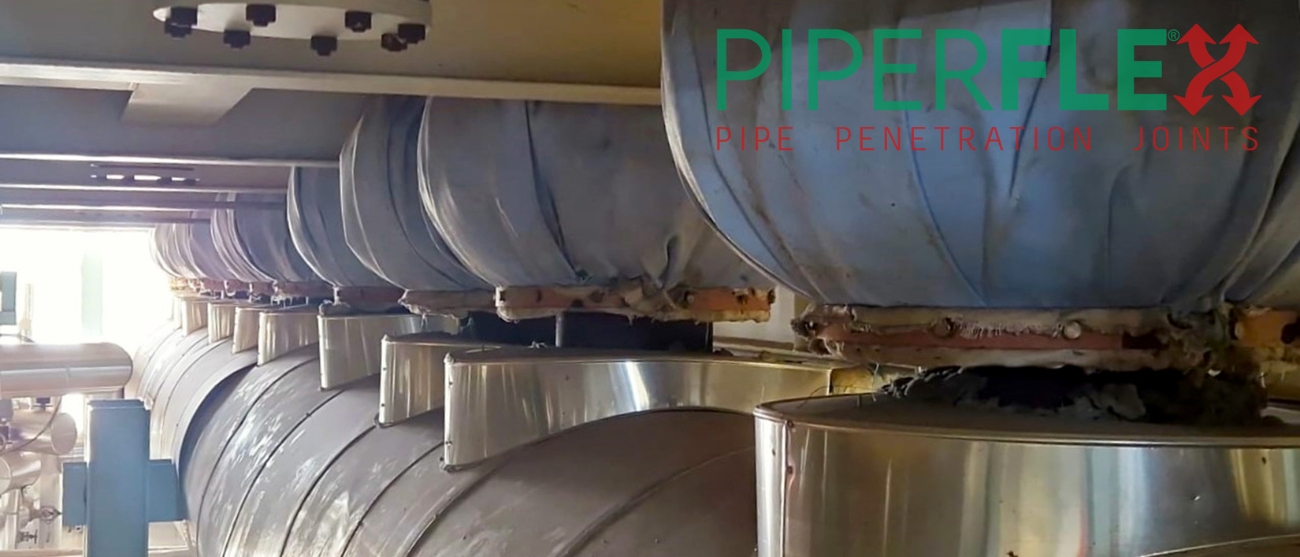
In this critical context Piperflex®  the textile through-wall expansion joint, designed by New Componit, establishes itself as one of the most effective and long-lasting solutions. A strategic choice that combines resistance, reliability and control, responding to concrete and increasingly pressing operational needs.

But what makes Piperflex® so reliable even in the most extreme conditions? Let’s find out point by point with a concrete look at its performance on the field.

Beyond the limits of metal expansion joints: Piperflex® in the most critical areas of HRSG plants

New Componit supplies textile expansion joints for all critical areas of combined cycle plants: from the air intake to the stack. In particular, Piperflex® is designed for the wall passages of HRSG boilers – an area subject to strong temperature changes, mechanical movements and high pressure.

This is where traditional solutions, such as metal expansion joints, begin to show their limits.

One of the strengths of Piperflex® is the ability to compensate for large axial and lateral movements ,protecting the structural integrity of the system and reducing the need for frequent interventions.

Unlike metal expansion  joints – which tend to wear out quickly under “stop & go” operating conditions – Piperflex® maintains high performance over time even in particularly unstable situations.

With a thermal resistance of up to 950°C and excellent gas tightness, this expansion joint is particularly suitable for the high temperatures typical of HRSG systems. Not only  it improves thermal efficiency, but it also helps to minimize the risk of dispersion and leakage.

Each Piperflex®  expansion joint is custom-designed: it is made after a careful analysis of the operating conditions of the plant, thanks to advanced design engineering, technical simulations and tests in a test chamber. The production is completely internal, to guarantee full control over materials quality and precision.

Also the installation is entrusted to highly qualified personnel, for an impeccable and long-lasting result.

More reliability, fewer surprises: Expansion Control System service

Piperflex® is not only an expansion joint. It is part of a comprehensive service that accompanies the customer at all stages: from design to post-installation maintenance. With the Expansion Control System program, New Componit provides a range of services designed to monitor the performance, identify potential problems and optimize plant management.

Technical support is provided by an international team of specialists, able to intervene anywhere in the world. This means controlled installation, on-site supervision, timely repairs and above all, preventive maintenance:an approach that prevents breakdowns, reducing operating costs and extending system life.

At a time when unplanned outages can cause considerable economic damage, having a joint that ensures operational continuity makes all the difference. Piperflex® is designed to resist, adapt and last and it does so without compromise.

Concrete benefits of Piperflex® include:

  • Superior reliability compared to metal expansion joints, even under irregular cycles
  • Maximum thermal resistance up to 950°C
  • Ability to absorb axial and lateral movements
  • Perfect gas tightness even under complex operating conditions
  • Custom and in-house manufacturing, with engineering materials selected to ensure high performance over time
  • Installation performed by certified teams
  • Ongoing technical support and proactive maintenance

Piperflex® is also a strategic asset for HRSG plants. Choosing it means reducing unscheduled shutdowns, containing downtime and achieving a tangible return in terms of business continuity and long component life

The robustness of an HRSG plant is also built through decisions that affect the most critical and stressed areas, when we talk about elements exposed to extreme conditions, what matters is the quality of the design and the precision of the implementation. Piperflex® is much more than a textile expansion joint: it is a guarantee of performance, a protection you can count on and an investment focused on operational continuity and sustainability.

Want to improve comfort and performance in your plant with a tailored solution?

There are fewer and fewer maintenance workers in plants, and the number of tasks each worker has to oversee is increasing. In the past, scheduled shutdowns, even of long duration, were periodically planned to carry out several checks and maintenance operations on plant equipment. Today, however, these types of shutdowns are becoming increasingly rare.

At New Componit, we felt it was important to adapt to these changes and offer, in addition to high-quality products, a dedicated maintenance service package. We aim to assist our customers before and after the product supply, as long as they need us. We have translated this 360° approach into a precise service package that we call Efficiency Box®.

Want to improve comfort and performance in your plant with a tailored solution?

When we talk about textile solutions for high temperatures inside industrial plants, we know that many related issues arise, such as the expansion of joints, energy efficiency, and personnel safety.

Over the years, by regularly visiting our clients’ facilities, we have learned to recognize these different issues and consequently to develop new products that can solve them.

In fact, all our products are developed based on the most common issues indicated by our clients. The opportunity to engage in dialogue with you and your team is crucial, as it provides us with the insights necessary to develop tailored solutions for any heat-related issues.

Want to improve comfort and performance in your plant with a tailored solution?

When visiting industrial plants, you can come across many situations and unforeseen difficulties, like finding sediments on walls.

Usually, sediments on walls are the result of residual unburned powders or stored powders which, if not promptly and adequately removed, tend to solidify and damage the relative equipment or structure.

To our customers who have reported this problem, we have recently started to offer the Safefon® sound cleaning system, which is a horn powered by compressed air, whose terminal diffuser, placed inside the structure to be cleaned, is able to remove the dust sediment from walls, through the emission of a sound wave.

Want to improve comfort and performance in your plant with a tailored solution?

In an industrial plant, whatever the sector it belongs to, several problems can arise; some of them are common and therefore easily solved. In other cases, however, may occur problems which are more complex to solve.

This is the case of granular materials: we are talking about that dust, which is formed during the industrial process and which can damage the equipment.

As it often happens, in these situations we tend to postpone a problem that doesn’t seem imminent or whose consequences are not immediately visible.

But it is exactly in these cases that, over time, develop encrustation which risk to compromise the proper working of industrial boilers, silos, furnaces, bag filters, heat exchangers, industrial fans, scrubbers, ducts and bag filter housing.

The industrial fields involved are the most different, just think about:

  • Dust from ceramic industry;
  • Steel dust from foundries or steelworks;
  • Gypsum from cement industry;
  • Dusty substances from food, chemical, or pharmaceutical sector;
  • Combustion ashes from power plants;

The incrustations that form are the result of the presence of unburned powders or stored powders which, if not correctly removed, tend to solidify, risking damaging the machinery or jeopardizing its functioning.

Let’s see some examples together:

  • in industrial fans, the accumulation of deposits on the blades can unbalance the rotor and cause dangerous vibrations.
  • ash deposits in boilers and heat exchangers can clog the pipes;
  • in silos the materials risk depositing and creating blockage.

In all these cases, we erroneously think that the dust removal entails expensive, bulky, solutions, also difficult to install/remove or even worse, that interrupts the production cycle.

New Componit has developed SAFEFON® horns, a sound cleaning system, which, unlike more traditional systems, such hammers, air blowers and mechanical retractors, it is versatile and efficient in removing dust.

The low-frequency and high-intensity sound waves create some internal vibrations, that affect the residual deposits and have a fluidifying effect.

The sound impulses are emitted by a pneumatic generator, their frequency is then modulated by a diffuser which can have different shapes and sizes depending on the application requirements and installation needs.

The Safefon® sound cleaning system:

  • doesn’t cause secondary effects to structures
  • is easy to install;
  • works in a fully automated way;
  • has no unwanted stops;
  • guarantees a reduction in operating and maintenance costs.

Want to improve comfort and performance in your plant with a tailored solution?