New Componit

From Efficiency to Safety: Strategies, Benefits, and Real-World Applications of Industrial Thermal Insulation

Today I would like to talk you about an issue that I have been hearing about for several months: the development of hexavalent chromium and derivatives on equipment thermally insulated.

I have thoroughly documented myself and I think it is worthwhile to make some consideration.

We at New Componit want to highlight the danger of working in contact with waste insulation materials in general and in particular, with those containing calcium which worked under defined operating conditions.

The good news? There are fabric solutions especially designed to prevent the formation of hexavalent chromium.

Want to improve comfort and performance in your plant with a tailored solution?

When we talk about textile solutions for high temperatures inside industrial plants, we know that many related issues arise, such as the expansion of joints, energy efficiency, and personnel safety.

Over the years, by regularly visiting our clients’ facilities, we have learned to recognize these different issues and consequently to develop new products that can solve them.

In fact, all our products are developed based on the most common issues indicated by our clients. The opportunity to engage in dialogue with you and your team is crucial, as it provides us with the insights necessary to develop tailored solutions for any heat-related issues.

Want to improve comfort and performance in your plant with a tailored solution?

Good morning, today I would like to talk to you about an important department of our company: the technical office.

Nowadays the technical office must be more and more flexible, working in close contact with sales office.

The work of our technical department is supported by a solid modeling software called “Solidwork”.

Working with a mathematical 3D model allows us to be able to analyze the object at 360° and therefore assess its exact dimensions; in this way we do not risk losing some details that with the 2D drawing might not be clearly visible.

Thanks to a 3D model that faithfully reflects the object, as it is made and installed, surveys are no longer necessary; the product is modeled directly on the object to which it will be applied, making the engineering process more streamlined and safer in terms of dimensional errors.

Want to improve comfort and performance in your plant with a tailored solution?


Davide Oldani – Technical Manager

For months now, there has been talk about the growing problem of hexavalent chromium formation on insulated structures in industrial plants.

Why has there been a debate on this issue?

Because this compound, resulting from thermochemical reactions among metal alloys containing chromium and oxides in conventional insulation materials, is a safety threat.

The danger of hexavalent chromium

Hexavalent chromium is classified as a very hazardous substance, with toxic effects on the environment and serious risks to human health. It is, therefore, essential to understand which situations are at risk and how to deal with them.

Since we have clearly in our minds what happened in the past with asbestos, we cannot ignore the situation and take decades before we recognise the hazardous nature.

It is therefore vital to understand the conditions that facilitate its formation. This compound is the result of a thermochemical reaction that causes the oxidation of chromium (contained in many metal alloys), under certain environmental conditions with the calcium oxide contained in many conventional insulation materials.

The result is a compound called hexavalent chromium, which no longer volatilises below 800°C.

But what are the environmental conditions to pay particular attention to?

  • The presence of ‘old style’ insulating materials containing calcium, sodium or potassium.
  • The reaching of operating temperatures between 300°C and 600°C.
  • The presence of metal alloys containing chromium.
  • A specific percentage of oxygen in the working environment

Should all these conditions occur, an imaginary alarm bell must be set off.

How to deal with the problem

Recognising the presence of hexavalent chromium is crucial. During dismantling operations the presence of a yellowish powder is an important indicator.

In such cases, it is essential to act promptly:

  • disassembly of insulators must be carried out by properly trained personnel;
  • the result of rapid chromium tests can confirm its presence;
  • in the event of a positive result, it is important to proceed with immediate remediation;
  • handling of materials contaminated with this compound must be entrusted to experienced personnel capable of working safely;
  • contaminated materials must be disposed of properly

But what preventive measures can be implemented?

The aspect of prevention is very close to our hearts: in addition to correct information on these risks, what preventive measures can be implemented in industrial plants?

New Componit’s response, which is the result of intensive product research and development, is the design of calcium-free high-temperature insulation systems to ensure the safety of people and environment, in full compliance with international occupational and environmental safety regulations.

Want to improve comfort and performance in your plant with a tailored solution?

Today I would like to talk you about the constant investment our company makes in employees training and professional development programs.

I would like to explore the many benefits this has brought to our organization and employees.

When a company invests in employee training, not only the employees but also the customers benefit from it.

In fact, relying on a constantly updated supplier means collaborating with someone who: wants to stay in step with changing times and evolve technologically to improve its products and services.

Want to improve comfort and performance in your plant with a tailored solution?

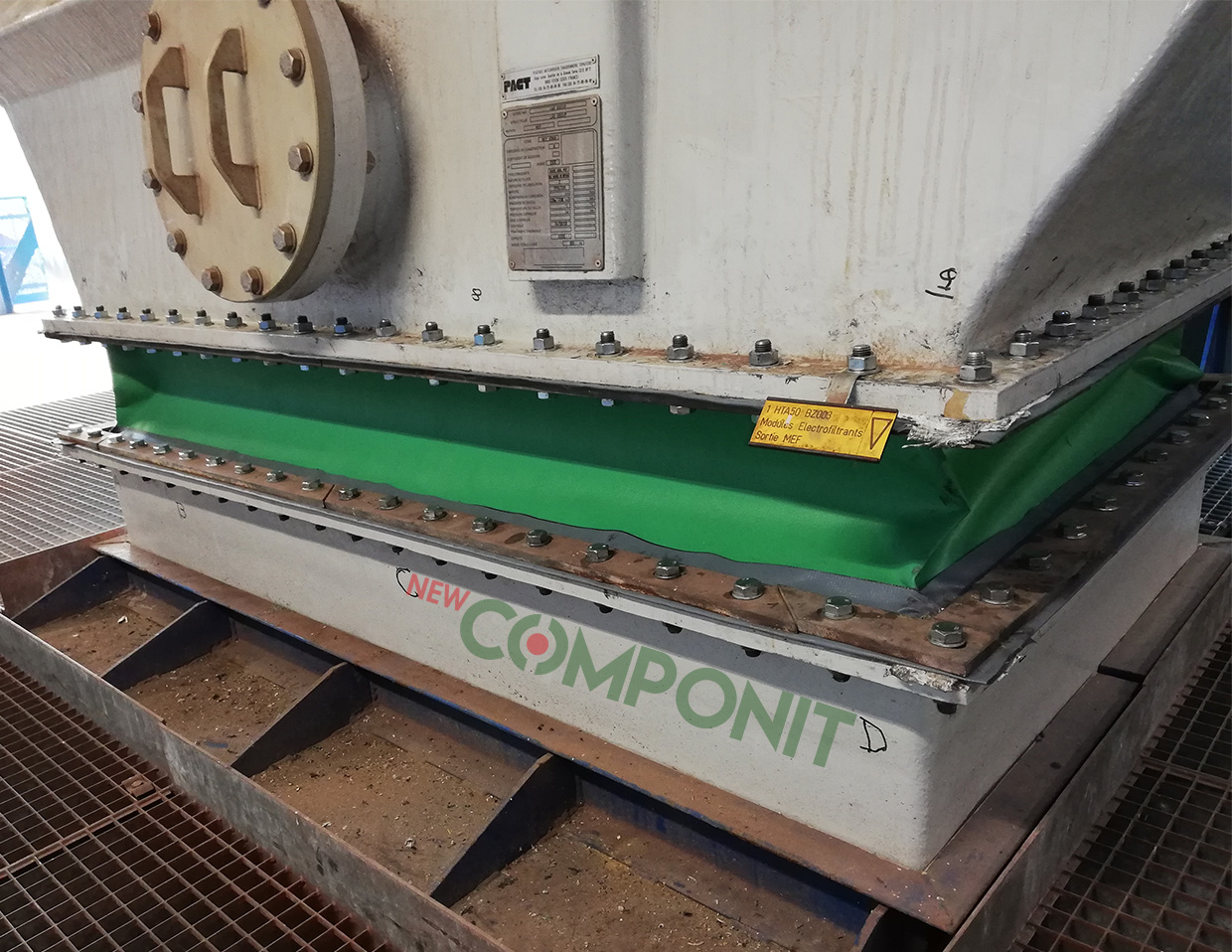
Today we are going to talk about fabric expansion joints and their correct installation.

In other previous posts we have focused on: the materials we use to realize them, their maintenance and the advantages that they can entail in a plant.

Why dedicate an article to installation?

A correct installation of the fabric expansion joint is as fundamental as its production. I can have a product perfectly made, using the best materials, but if it is installed incorrectly, the fabric expansion joint is not really effective.

Safety first

It happens that companies get in touch with us to buy fabric expansion joints specifying that they do not need support for the installation .

However, it should be kept in mind that, the installation of fabric expansion joints by unskilled personnel entails a number of safety risks to employees, especially when the system is in operation or in half service. Just recently, two workers of one of our customers were injured, by getting burned while they were assembling our products.

In fact, fabric expansion joints are installed in parts of plant where fluids, in a gaseous state, usually flow and which, besides very high temperatures, may contain chemicals or acidic components. These characteristics make the installation step somewhat “delicate”; this is why it is an operation that should not be underestimated at all.

If the expansion joint is not installed correctly, fluid spills can occur and be a health hazard to operators who, as they pass in the vicinity of these areas, risk being burned or coming into contact with chemical agents.

It is not only people who are at risk, but also any equipment that is in the vicinity of an expansion joint which is leaking.

The operation of the plant

In addition to safety, which we would like to remember comes first, we have to consider the plant performance.

If there are fluid leaks, it means that the plant is not working to its full capacity. In such cases, there is a risk of compromising plant operation with the occurrence of sudden and recurring plant shutdowns.

This situation obviously leads to losses in efficiency and considerable economic damage.

The position of fabric expansion joint

A question to which usually we do not pay attention is space. In many cases the fabric expansion joints have to be installed in narrow spaces, difficult to reach. The operation area for the employees involved is limited and the risk of making mistakes is very high; as a result, the installation becomes more complicated.

And then, in light of these considerations: how can we properly install the expansion joint?

Our answer is: delegate the installation to specially trained personnel or provide for the supervision of skilled technicians. Only in this way, we can be sure to install properly the expansion joint and reduce the risk of occurrence of situations as described above.

We also must keep in mind that no fabric expansion joint has a 100% seal, therefore the proper installation is essential to avoid fluid spills or minimize this possibility.

For all these reasons, we at New Componit have created, within our staff, a division exclusively dedicated to installation or assembly supervision. They are specifically trained technicians with decades of experience on site, able to work anywhere in the world.

Want to improve comfort and performance in your plant with a tailored solution?

My Agile Privacy
Privacy and Consent by My Agile Privacy

This site uses technical and profiling cookies. 

You can accept, reject, or customize the cookies by clicking the desired buttons. 

By closing this notice, you will continue without accepting.