
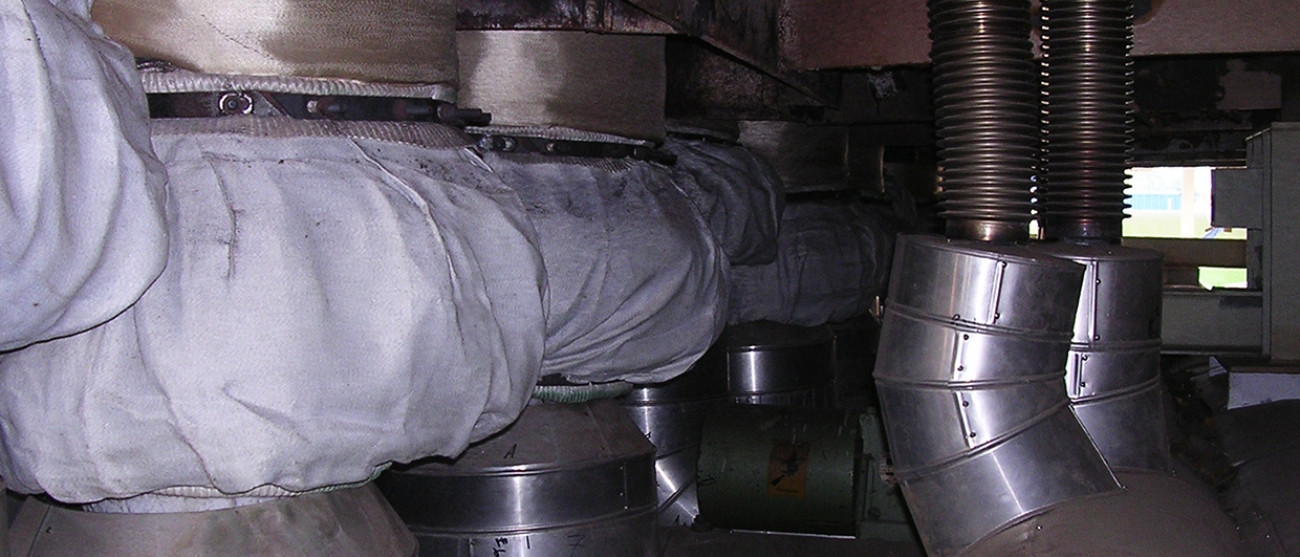
Have you ever come across a fabric expansion joint that has deteriorated earlier than expected, for no apparent reason? In most cases, the answer does not lie in the quality of the expansion joint itself. It lies in what has been placed on top of it.
When a component designed to move and dissipate heat is treated as a fixed pipe, wear and tear accelerates and the problem only becomes apparent months later, during maintenance, by which time the damage has already been done. Understanding why this happens is the first step towards preventing it from happening again.
A fabric expansion joint is not a pipe: treating it as such has a cost
A pipe is static. You cover it, insulate it, fit a metal sheet over it and leave it alone for years. A fabric expansion joint works in a completely different way: it absorbs the thermal expansion of the duct and dampens vibrations, which means it has to move with every thermal cycle and every change in pressure.
If you encase it in a rigid cover, you are working against its natural function. The fabric continues to move – it cannot do otherwise – but it does so against a constraint that was not intended. Over time, that constraint becomes the main cause of premature deterioration. It is not a question of the quality of the material, but of how it was installed.
When heat cannot escape, it builds up where it shouldn’t
There is a second effect, less visible but just as significant. The fabric expansion joint is designed to release heat to the outside, so when you cover it with a tightly-fitting metal sheet, that heat becomes trapped between the fabric and the covering.
In technical terms, this is known as ‘heat trapping’. Internal temperatures rise above design specifications, the fabric operates under more severe conditions than anticipated and its service life is consequently reduced. From the outside, nothing appears amiss. But the process is already underway, silently, with every cycle.
Two solutions that protect without stopping the movement
If you want to reduce heat loss along the duct without damaging the expansion joints, there are two approaches that that can solve the problem at its root
- The bolster bag is a flexible insulating product that is installed beneath the expansion joint, between the fabric and the supporting structure. It protects against radiant heat without restricting movement. It is removable, making it ideal for those who need to inspect the joint during routine maintenance without having to perform any additional operation.
- A spaced exterior cover is the right choice when protection from impacts or the elements is needed. In this case, the cover is kept raised above the expansion joint, with a ventilation gap that allows heat to dissipate normally. That spacing is not a compromise, but an integral part of proper operation.
Two different solutions for different needs. Both are based on the same principle: the expansion joint must be able to do its job.
Proper insulation means knowing what you’re insulating
Every component of a system has its own requirements and an effective insulation plan starts with this distinction. Fabric expansion joints aren’t a difficult-to-manage exception; they’re simply elements that require a different approach than the standard one. Recognizing this early on means avoiding premature replacements and unplanned downtime that could have been prevented by making a different choice during installation.
If you’re evaluating how to manage textile expansion joints in your system, or if you’ve already noticed signs of wear that you can’t explain, New Componit’s technical team is available for a direct consultation. Let’s analyze the situation together and we’ll recommend the solution best suited to the actual conditions of your system.
Contact us anytime:

 Sales Manager
Responsible for commercial management and the development of business opportunities in the fields of industrial insulation and expansion joints.