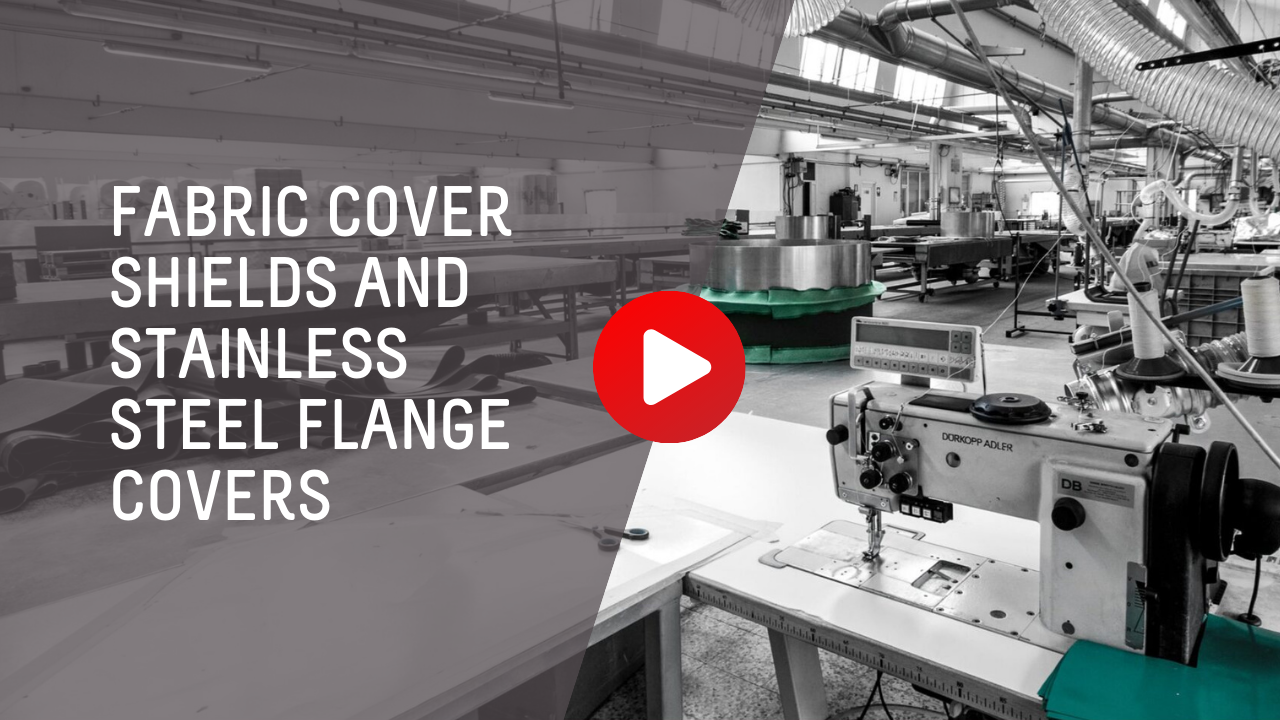
In a piping system, joints and threaded fittings in flanges form, rather than sockets or expansion joints are obviously a daily occurrence.
Flanges
Within a piping system, the flange is therefore a mechanical part intended to provide a non-permanent connection between two pipes. They are points where pressure, heat, vibrations are particularly strong and above all they are structurally weak points, because they are contact points between different connections.
They are points that cannot be welded to increase their resistance, as they must allow disconnection between pipes for scheduled or accidental maintenance.
Why cover the flanges
Because they are “weak points“, in a piping system it is important to cover the flanges so that operators can work safely.
Flanged couplings crossed by chemically aggressive products or any potentially harmful product are a source of risk to the safety of personnel. In the event of failure, the liquid flowing inside can be projected from the flange coupling in a wide radius and with high kinetic energy (a phenomenon known as “Jet Fire“).
For this reason, flange couplings must be provided with adequate protection against such events.
How to cover the flanges?
There are two ways to cover the flanges properly by using: metal flange safety shields or fabric flange safety shields.
Metal flange safety shields are realized with different types of stainless steel, depending on the fluid flowing through the pipes, so that in the event of a leak the flange safety shield will tend to contain the fluid inside, letting it to drip to the ground, in this way the pressure is eliminated .
In particular, New Componit metal flange safety shields are made of Stainless Steel 304, Stainless Steel 316 L and Stainless Steel 310.
Metal flange safety shields are very strong, have a very high durability, but have the drawback that they do not contain heat.
Textile flange safety shields, on the other hand, are designed with special technical fabrics, depending on the type of fluid that is conveyed in the pipes and the temperature that can be reached. Among the materials that can be used there are fibreglass and PVC.
Compared to their metal counterparts, textile flange safety shields have the advantage to be heat-insulating. This is important in all situations where the fluids flowing inside the pipes are particularly hot, because it allows the operator to work without the fear to get burned.
Furthermore, since they are “custom-made“, the textile flange safety shields can be used where traditional metal insulation cannot be, for example: because there is no space for its installation or because of the conformation of the system itself, so the flange is in a “difficult” place or has been designed in a particular way.
Are you looking for a supplier to secure your flanges?
New Componit is a company that has been working in the field of fabric joints and industrial fabric insulation since 1986. Our experience in designing custom-made solutions for all our customers can guarantee a solution to any problem about safety and heat dispersion in plants.
Want to improve comfort and performance in your plant with a tailored solution?
 Sales Engineer
Coordinates the development of the Textile Products division, focusing on the analysis of new sectors to approach and the commercial and marketing strategies to implement.