New Componit

Tommaso Gatto

In industrial plants some components (which should be considered of primary importance) are underestimated,  we particularly see it in the expansion joints field.

As a matter of facts, the pipes are subject to frequent expansions, generated both by different temperatures and/or internal pressures, and by external movements.

In order to fully perform its functions (thermal abatement and mechanical resistance) the expansion joint must be correctly chosen and designed, according to the operating condition.

It is necessary to select the proper material to use : pressure drops and heat losses can cause low production performance , dangerous risks of environmental pollution and high operating costs

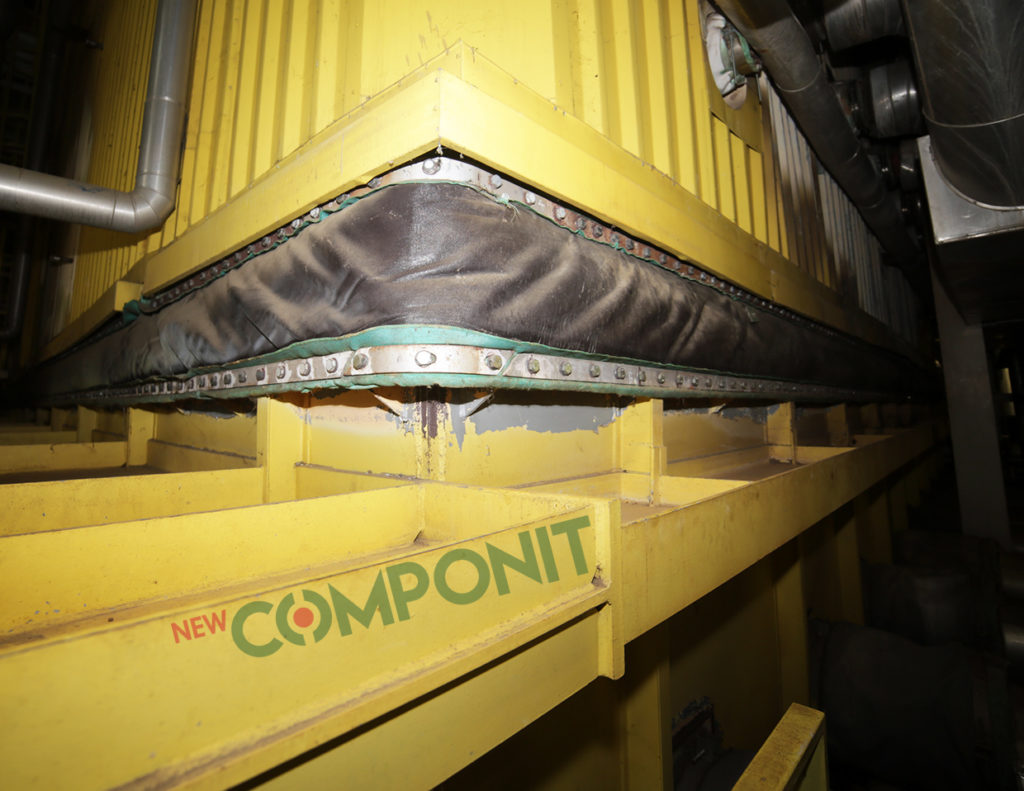
Fabric expansion joint

The fabric expansion joint is a flexible and strong component; it is not suitable for plants which carry liquids, because of the composition of its layers.

It is a connection between two piping portions, that avoids the transmission of vibrations and movements generated by gaseous fluids flowing.

It can withstand high temperatures even over 1000°C and compensate large movements.

The fabric expansion joint is made up of one or more layers of different materials, each one with a specific task.

There are materials designed for thermal abatement, others intended to withstand the corrosive attacks of fluids, others which ensure pressure tightness.

From the appropriate overlapping and/or combination of these materials, we obtain a stratification which has the suitable characteristics for any specific project condition. This is why the fabric expansion joint is very versatile.

This type of connection is mainly used to absorb the thermal expansions generated by the temperatures of fluids flowing inside the pipes. It can also be used as a connecting element between equipment and piping with anti-vibration function.

Therefore, unlike metal or rubber expansion joint, the fabric one is extremely flexible, but it is not elastic.

There is a clear proportion between movements, installation length and width and construction length and width.

In order to absorb the movement, the expansion joints are made wider than the installation width, so that the material can allow the device to work properly.

It is obvious that the wider the movements are, the greater the abundance  of material must be, especially in the case of stretching movements.

They can be supplied complete with an internal bolster bag. The purpose of this insulation is to eliminate any dust deposits, to prevent damaging oscillations of expansion joint, caused by the pulsating pressures (thanks to their volume) and to provide a valid support to the expansion joint itself, preventing it from going into depression.  In addition, the bolster provides thermal and acoustic insulation.

The multilayer  fabric expansion joints, have necessarily to be able to dissipate the heat that passes through them. Any element that prevents or limits this step must be avoided.

Therefore insulation that cover the external part of expansion joints are not permitted, excluding the ones working at low temperatures, which have to be evaluated case-by-case.

Metal expansion joint

Metal expansion joints are also used in piping systems to absorb movements caused by temperature and pressure.

They are used to compensate for movements in the axial or lateral direction and to compensate for angular deviations in the geometric axes of the flanges. Torques are transmitted rigidly and without backlash.

Suitable for liquid and gaseous fluids. High pressure and temperature.

They are largely used in : refineries, chemical plants, power generation, heating and air conditioning systems, research, automotive and cryogenics.

Depending on the direction of movements and operating conditions, there are different types of metal expansion joints: axial, lateral angular and combined, which must be accurately examined and assembled .

Therefore, it is absolutely necessary a prior assessment of the installation  in order to find the most suitable solution; solution that only a skilled partner will be able to suggest you.

Underestimating the problem, that can arise from a wrong assessment of the compensator to be used, whether textile or metal joint,  is dangerous, not only in terms of low performance.

New Componit is an experienced and qualified company: we at New Componit have been working for 30 years in the production of fabric joints, protections and custom-made items for industrial plants.

This is why we have developed the Efficiency Box® program, which offers you a custom-made analysis of your plant together with design and constant support by our highly qualified technicians:

  1. Efficiency tests
  2. Dedicated skilled team
  3. After-sales assistance and periodic supervision
  4. Certifications and guarantees

Want to improve comfort and performance in your plant with a tailored solution?

No, they are not and now I try to explain you why.

The legislative regulations concern all the equipment and protection systems intended to be used  in potentially explosive atmospheres.

  • Fabric expansion joints
  • Rubber expansion joints
  • Insulation covering

These products do not carry a flammable fluid and are part of a system which is already subject to ATEX certification.

The equipment defined by ATEX directive are: “machines, systems, fixed or mobile devices, components and control instruments, detection or prevention systems which are partially or entirely intended for the generation, transport, storage, measurement, control and energy conversion and/or treatment of materials which may cause an explosion due to their potential ignition sources “. (Article 1, paragraph 3)

The equipment which are part of ATEX directive have an independent function and their own ignition source.

Products that are in accordance with the definition of equipment but do not have their own ignition source are “outside the scope of ATEX directive”. Therefore, products such as manual valves, pressure gauges, pressure regulators, etc. are “outside the scope of the directive” if an ignition risk analysis shows that they do not have their own ignition source.

This does not include ignition hazards resulting from assembling these products in a circuit.

However, when we know that our products will be used in the Atex area, we use fabrics suitable for this type of environment, which are conductive, i.e. with a surface resistance a value that determines their absolute suitability for this use.

Want to improve comfort and performance in your plant with a tailored solution?


Even when your company’s plant seems to be working normally, joints may suddenly lose efficiency without warning.

Furthermore, it’s normal for the performance of expansion joints in piping systems to deteriorate over time. This can lead to a waste of time and money, or cause much more serious problems relating to efficiency and safety.

But first, a question for you:

What do you know about textile joints?

Prevention is better than cure

If you have an industrial plant, you will know that pipe systems carrying gases are very rigid, though delicate, structures. They are often damaged by mechanical stress, changes in temperature and pressure, and vibrations or movements not originally allowed for.

That’s why expansion joints are essential for your plant!

Textile compensators are ideal for this purpose. They are made from layers of different materials, chosen to suit the conditions of use and the fluid to be transported.

Because they can withstand high temperatures and chemically aggressive environments, they find common use in the industrial and shipping sectors in particular.

Textile compensators allow very wide pipe movements or displacements to be precisely compensated at any temperature and pressure, especially when gases are being transported.

Textile joints are also extremely versatile, since they can be made in any shape and size, and can be closed or opened with or without a metal support structure.

In short, they are unique, high performance products that can satisfy the most diverse operational requirements.

Now all that remains is to select the best joint for your plant.

The choice will depend on many factors, primarily the operating conditions and functional requirements. Other aspects (temperature, pressure, chemical composition, movements, thermal and acoustic abatement) must also be considered in determining the type of stratification required.

Finding the most suitable solution for all your plant’s problems will inevitably require the services of highly qualified and specialised producers.

The importance of checking your plant

Textile expansion joints are not all the same, nor should their value be underestimated, as they play a decisive role in the proper functioning of your system by controlling the compensation of expansion and limiting the effects of vibration.

For this reason, detailed analysis of your plants’ piping systems should be performed periodically. Monitoring or thermal analysis of joints by means of thermography is important for checking the proper functioning of the entire system.

Textile joints must be replaced or repaired at the first sign of wear. This should never be neglected, as these joints are indispensable in ensuring plant efficiency and protecting the environment and the safety of workers.

Would you like to know how efficient your plants are?

This is your opportunity to learn about a company that offers an alternative to normal joints. New Componit has been producing customised products for high temperature environments for over 30 years.

Continuous research and inquiry into materials and production techniques enables us to offer our customers innovative, high performance products. 

Our customised Efficiency Box® programme gives you analysis, planning and constant support from our specialised technicians.

We guarantee you: 

  • Efficiency tests
  • A dedicated specialist team
  • After-sales assistance and periodic monitoring
  • Certification and guarantees

New Componit also offers a repair and maintenance service to help you minimise costly interruptions to production.

Want to improve comfort and performance in your plant with a tailored solution?