
Before planning insulation work, many companies believe they already know their plant inside out. After all, they work there every day. They know where the pipes are hot to the touch, where the air is heavier, where you can feel the heat from a distance.
However, this familiarity can be misleading. Knowing a system is not the same as having a complete picture of its energy status. And without that picture, any decision risks being based on impressions rather than concrete facts.
Insulation work on industrial plants may seem like a minor technical operation. In reality, it has significant strategic importance: it reduces heat loss, improves the overall efficiency of the plant and keeps operating costs down over time. We are talking about work that may involve pipes, valves, flanges, tanks, heat exchangers, or any component exposed to significant temperatures.
When well planned, they bring immediate and measurable benefits. But if they are based on incomplete or inaccurate information, there is a real risk of: investing in the wrong areas, underestimating the real priorities, or designing solutions that do not work as they should.
What you need is a technical picture, a snapshot that shows where energy is being lost, how much is being lost and what the real priorities are.
No assumptions. No rough estimates. Just rigorous mapping based on measurable data and thermographic analysis.
Because only when you have this snapshot you can make an informed decision about whether to take action, where to do so, and what return to expect.
The 7 pieces of information that distinguish a technical picture of the system from a quick glance
A serious energy audit is not limited to walking around the system with a thermal imaging camera. It collects a series of in-depth information that makes the difference between an effective intervention and one that does not produce the desired results.
Below is the information that should emerge from a well-done analysis.
1. Which parts of your system need insulation
Not all components are the same and not all require the same type of attention. An accurate analysis pinpoints exactly where insulation is completely missing, where it has been damaged over time, where it has only been partially installed and where it is simply old and no longer effective.
This mapping allows you to focus resources and energy on the points that have a real impact on consumption, without wasting budget on marginal interventions.
2. Which components are examined
The analysis does not stop at the main pipes. It covers the entire heating system: pipes of all diameters, valves, flanges, pumps, filters, tanks, heat exchangers, expansion joints. Any element that operates with hot or cold fluids and that could be a source of dispersion.
The more thorough the investigation, the more reliable the final picture.
3. What is your current energy consumption?
Knowing how much you are consuming today is the starting point. But even more important is understanding how much of that consumption is related to avoidable losses. The analysis quantifies energy losses through thermographic measurements and engineering calculations that take into account surface temperature, component size, and operating conditions.
4. What energy savings are realistically achievable?
The audit calculates potential energy savings in terms of kWh or MWh per year, providing objective data that allows you to assess whether the investment makes sense from a technical and economic point of view.
5. How much CO₂ reduction can you expect?
Every kWh that is not wasted also translates into lower carbon dioxide emissions. The analysis quantifies this environmental impact, providing a clear picture of the contribution to corporate sustainability. This is an increasingly important aspect, both for regulatory and reputational reasons.
6. How much money can you save?
Energy savings are translated into annual financial savings based on the company’s specific energy costs. Once the project has been studied, this information will be useful for evaluating the return on investment in concrete terms and making financially sound decisions.
7. Where are you losing energy
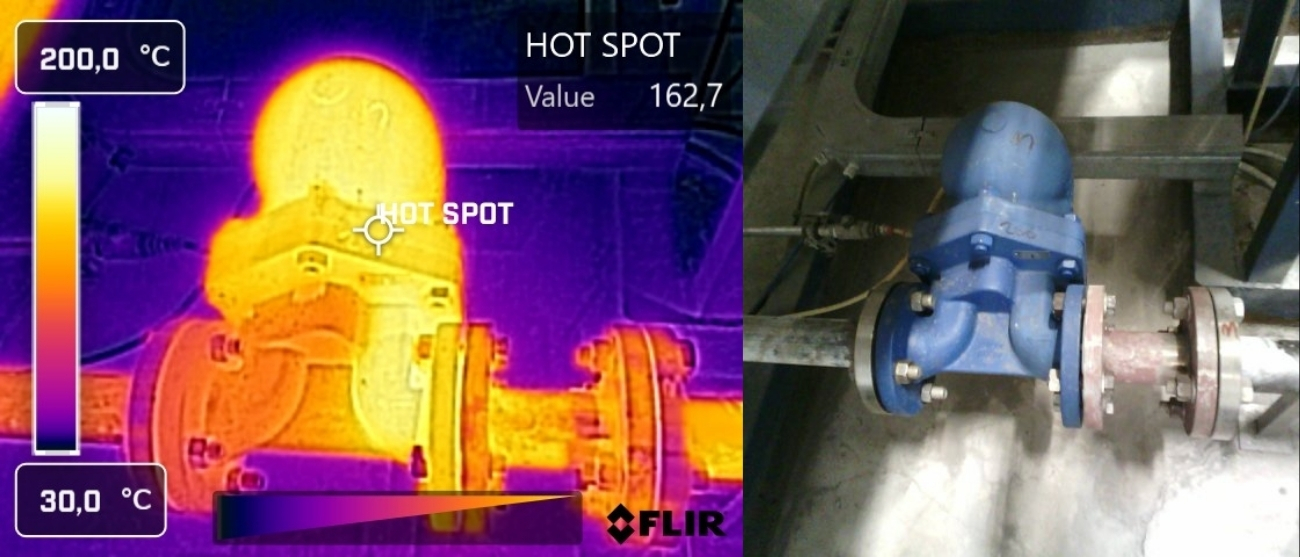
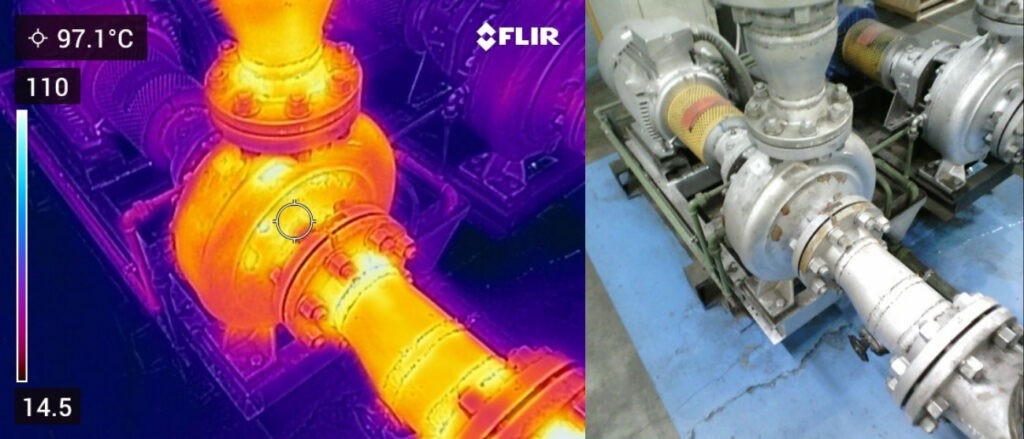
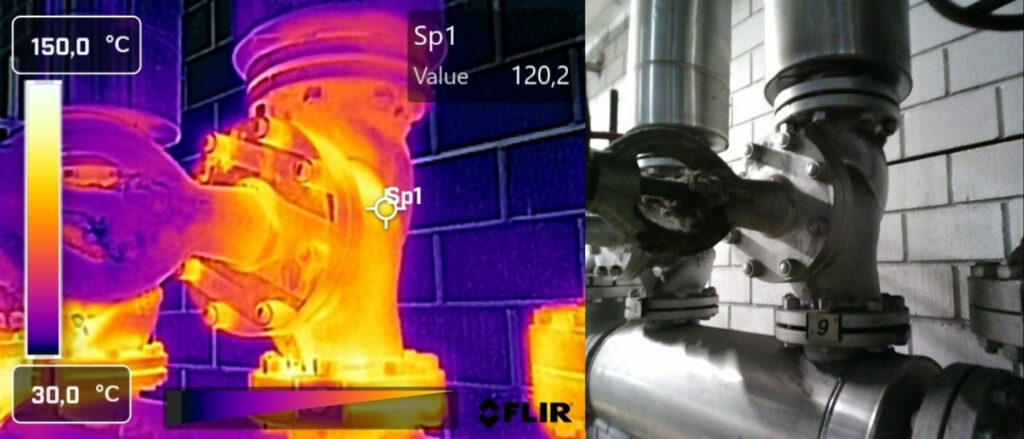
The most visible part of the analysis is the photographic and thermographic report. Infrared thermography clearly shows the areas where heat is being lost, making the situation immediately understandable. These images speak for themselves.
This picture has a name: TipCheck
TipCheck is the standardized energy audit developed by New Componit, an accredited member, since 2019, of EIIF ( European Industrial Insulation Foundation).
Thanks to this certification, New Componit conducts energy audits with personnel qualified according to EIIF standards. The goal is to provide companies with an accurate diagnosis of the energy status of their plant, with objective data on which to base informed decisions: not impressions, but concrete numbers that show where, how much, and why energy is being wasted.
TipCheck quantifies the potential energy, environmental and economic savings in an objective and comparable way. It avoids wasting resources on non-priority or poorly dimensioned interventions. It transforms uncertainty into a strategy.
With this snapshot in hand, you may also decide not to take action. But at least you do so with full awareness. Or you can choose to improve the energy status of your system. In that case, you know exactly where, how much, and with what expected return.
If you want to learn more about how much you are wasting and how much you could save, request our TipCheck !
Start thinking of cleaning as an invisible but continuous activity that works alongside you. Production doesn’t stop. Neither does cleaning.

 Project Engineer
Level 2 TIPCHECK Expert, he puts his technical expertise at the service of customers to deliver reliable, high-performance, and high value-added solutions for industrial plants.